TradingKey - UnitedHealth Group (UNH) has shown good progress on its operational turnaround, but fresh Medicare Advantage (MA) Star Ratings and increased regulatory scrutiny present new risks. UNH closed at $370.95 on October 8, down 1.34%, for a market cap of approximately $333B.
What is most interesting is the rapid change in the investment case for UNH. Earlier in the year, the focus was on the 2025 Medical Utilization Shock and whether UNH could control costs post-2025. Q2 results show the company is on track to recover post-2025 costs, but the market must take into account how UNH will be impacted by recent Star Rating downgrades and ongoing regulatory investigations.
Medicare Star Ratings Create a Fresh Headwind
The 2027 Star Ratings will affect 2028 Medicare Advantage quality bonus payments. Lower ratings can reduce future quality bonuses and pressure plan competitiveness, but they do not directly mean fewer plans or lower 2027 reimbursement. Added to this is increasing regulatory uncertainty around UnitedHealth.
The release of the 2027 CMS Star Ratings by the Centers for Medicare & Medicaid Services (CMS) on October 8 was one of the more notable developments this month. CMS reported that 37% of MA-PD plans earned a rating of four stars or greater for 2027, covering approximately 71% of total enrolled members across the industry.
UnitedHealth Group (UNH) reported mixed results. Three UnitedHealth contracts earned five-star ratings, including two Care Improvement Plus South Central Insurance contracts and Sierra Health and Life, while others lost stars for 2027. Additionally, Reuters reported that UnitedHealth’s average ratings declined by about 15% from the previous year.
Losing quality star ratings can adversely impact the competitiveness of UnitedHealth’s plans, especially if these star ratings fall below 4.0. Plans rated four stars or higher qualify for Medicare quality bonus payments, and the 2027 ratings will affect 2028 bonus payments. Most importantly, weaker ratings could pressure UnitedHealth’s future Medicare economics and plan competitiveness. This means controls will need to remain in place to offset rising medical costs.
UnitedHealthcare Is Reshaping Its Medicare Business
UnitedHealthcare is currently restructuring its Medicare portfolio for 2027, which comes as UnitedHealthcare is losing some Medicare plan ratings. UnitedHealthcare has stated that 94% of all Medicare eligible members will still be able to access a UnitedHealthcare Medicare plan and 90% of members will have the opportunity to access a UnitedHealthcare Medicare Advantage plan with a $0 premium.
UnitedHealthcare is expanding its Special Needs Plans (SNP) and Health Maintenance Organization (HMO) Plans. For 2027, it is projecting that approximately 95% of Medicare-eligible individuals in its footprint will be able to access an HMO plan, with most having a $0 premium.
UnitedHealthcare states that for 2025, HMO members spent more than $175 less per year out-of-pocket than LPPO members.
Because UnitedHealthcare's HMO networks are concentrated in a particular geography, UnitedHealthcare can achieve better cost savings. The biggest question will be how many members UnitedHealthcare loses in the process.
Q2 Showed the Turnaround Is Working
UnitedHealth reported very strong results for Q2. Revenue came in at $112.0 billion and earnings from operations increased to $8.0 billion. Adjusted EPS was $6.38.
The medical care ratio improved significantly and came in at 86.7%. Management attributed this improvement to better design and management of the company’s products, along with changes in the membership mix and pricing.
I would watch the medical care ratio closely on October 13. Historical issues regarding UnitedHealth, related to healthcare costs growing at a faster rate than reimbursement, primarily drove the company’s problems in 2025. Therefore, a continued downward trend in the medical care ratio would demonstrate that the company has successfully reset pricing and benefits in an effort to restore margins.
Q2 results also included $860 million of net favorable prior period adjustments, thus, investors should not automatically impute every basis point of improvement to a repeatable trend. Rather, the case would be more compelling if the company is able to continuously control its costs at an improved level, without relying on prior period adjustments for help.
Guidance Was Raised Sharply
UnitedHealth posted better than expected second quarter results, and increased their full year guidance to 19.50-20.00. They expect at least $24 billion of operating cash flow and at least $5 billion of share repurchases in 2026.
UnitedHealthcare is estimated to produce operating earnings in excess of $12 billion for the year, with the remainder of earnings driven by Optum.
Management raised their full year guidance on July 16 after the Q2 results. In my opinion, if the revenue and earnings improvement at UnitedHealth was a temporary improvement, I would expect the management team to maintain the guidance.
Optum Is Recovering Faster Than Expected
During Q2 2026, UnitedHealth's Optum had revenue of $65.7 billion and operating earnings of $4 billion, with operating earnings up approximately 29% year over year and operating margin expanding by 160 basis points.
Other Key Initiatives
UnitedHealth has said they intend to spend $1.5 billion on AI in 2026, and at least the same amount in 2027. The goal is to reduce the administrative burden on employees and clinicians and improve workflows.
Effective September 28, Jodee Kozlak was named the first ever chief administrative officer at UnitedHealth. The company said this role is focused on modernizing the company and aligning their business, as well as simplifying their processes.
This role was also created to improve processes and operations of the company as they continue to integrate businesses that have been acquired in the past.
Texas Investigation Adds Another Regulatory Risk
On October 5, another, more immediate regulatory risk, emerged when Texas Attorney General Ken Paxton launched an investigation into UnitedHealth Group (UNH) regarding denials of health insurance coverage and decisions affecting patient care.
The Texas Attorney General issued civil investigative demands, (CIDs), to UnitedHealth seeking evidence of potential violations related to coverage denials and patient-care decisions. Specifically, the investigation includes allegations involving medical necessity, prior authorization and other coverage practices.
It is important to distinguish between allegations and wrongdoing. The former describes the state of the evidence, and the latter describes a judicial ruling or other legal determination.
Beyond the Texas inquiry, UnitedHealth faces federal scrutiny for its activities in the Medicare program. The company has said it is working with the U.S. Department of Justice (DOJ) in response to formal civil and criminal requests.
Independent Review Provides Important Counterevidence
Also, UnitedHealth has published results of an independent FTI Consulting review of the 2025 HouseCalls coding practices. FTI reviewed a random sample of 200 HouseCalls visits comprised of 494 diagnoses.
In a first-pass review, 96.6% of the sampled diagnoses were supported by the medical record. After reviewing the broader patient care and paid-claims history, FTI found 99% of the diagnoses were documented in the medical record or reflected in paid claims.
While this does not eliminate regulatory risk, it provides meaningful evidence against the broad unsupported coding of UnitedHealth's HouseCalls visits. Therefore, investors should distinguish allegations (which remain under investigation) from confirmed evidence of wrongdoing.
October 13 Is the Real Test
UnitedHealth has set Q3 earnings results for October 13 before the market opens, with the earnings call at 8 a.m. E.T. I will focus on the medical care ratio, Medicare Advantage membership, Optum Health margins, full-year earnings per share (EPS) guidance, operating cash flow, and management’s explanation for the new Star Ratings.
At $370.95, the stock trades at approximately 23.9 times trailing earnings and 17.4 times forward earnings. While that valuation isn’t extremely high if the turnaround continues, it could be if the stock fails to perform or further regulation of Medicare affects the business.
An improvement of the medical care ratio with maintenance or upside to the $19.50 to $20.00 adjusted EPS range would improve my opinion on the stock. Renewed medical cost inflation or guidance that unfavorable Star Ratings would negatively impact earnings in a material way would be a negative.
UnitedHealth Technical Analysis: UNH Faces Downtrend Resistance as $362.48 Support Comes Into Focus
UnitedHealth ended the day on October 8th at $370.95 after touching the descending trendline and getting rejected from the resistance at $382.77 to $385.14. What I want to point out is the failure to recover above the moving averages and the repeated formation of lower highs. The latest bearish candles indicate sellers are in control of the short-term trend.
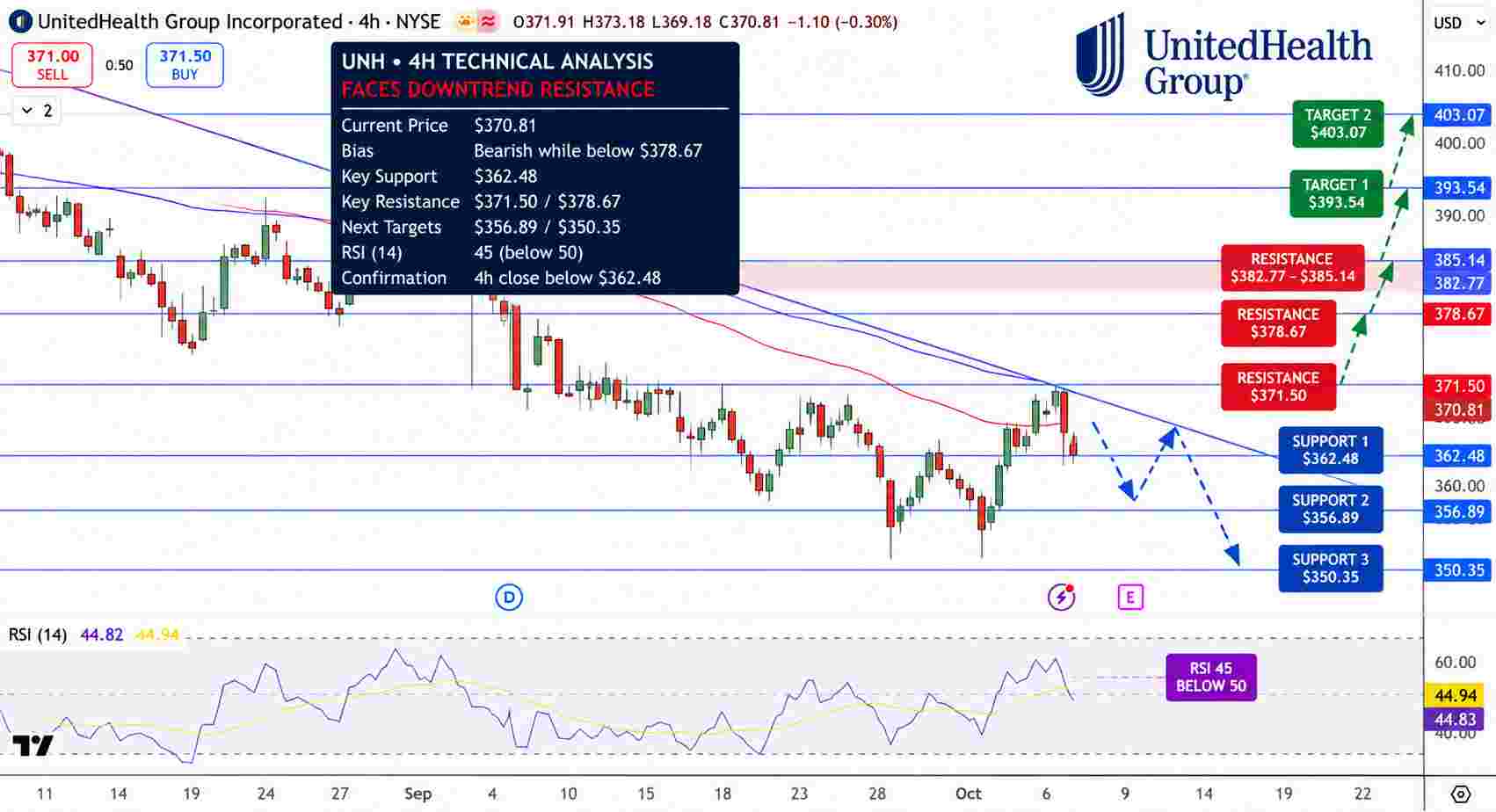
UnitedHealth Stock Price Chart - Source: Tradingview
RSI is around 45 and has been below the neutral 50 level. The recent formation could indicate RSI could be heading lower, but it would need to break below its signal line to confirm bearish momentum.
$362.48 is the next major support. If sellers are able to break below $362.48 on the 4-hour timeframe, it could set the next lower target of $356.89.
In order for the bearish outlook to change, UnitedHealth would need to break above the $378.67 50-period moving average and the descending trendline.
$393.54 would be the next major target if the descending trendline and the $382.77 to $385.14 resistance is taken out. A sustained move above $385.14 would materially improve the short-term outlook.
Key Levels
• Latest completed close: $370.95
• Major support levels: $362.48, $356.89, $350.35
• Major resistance levels: $371.50, $378.67, $382.77 to $385.14
• RSI: approximately 45
• Recovery trigger: sustained move above $385.14
• Breakdown trigger: 4-hour close below $362.48
Why is UnitedHealth stock in focus now?
UnitedHealth is under the microscope as the company is expected to release Q3 earnings on the 13th, just a few days after the CMS released the 2027 Medicare Star Ratings, which were below expectations. Meanwhile, management raised its EPS forecast for the year, after Q2 earnings and the company's medical costs reportedly improved.
What level confirms a stronger UNH recovery?
A close above $385.14 would remove the bearish trendline and improve the short-term outlook. $393.54 would be the next target. A close below $362.48 would restore the bearish bias and bring $356.89 into focus.
Bottom Line
For Q3, the CMS Star Ratings aren't favorable for UnitedHealth, and the company has complex regulatory and Medicare issues. It appears management is operating strongly, as the Q2 medical-care ratio improved, cash flow and earnings were solid, Optum margins improved and management raised EPS. The technical setup remains bearish while UNH trades below the $378.67 to $385.14 resistance area, and the stock will likely move in the direction of the trend until the company reports Q3 results. The 2027 Star Ratings create a future reimbursement and competitiveness risk that management will need to address.
Find out more